

Air purifiers filter airborne particles like dust, pollen, and pet dander out of your air. Humidifiers add moisture back into air that’s too dry. Choose a purifier for allergies, smoke, or pet-related symptoms; choose a humidifier for dry throat, cracked skin, or nosebleeds. Plenty of homes, especially through a Canadian winter, need both.
TL;DR:
- Air purifiers with true HEPA filters effectively remove at least 99.97% of particles down to 0.3 microns, including allergens, pollen, and smoke, when properly sized for the room using the CADR rating.
- Humidifiers with built-in humidistats maintain optimal humidity levels between 30% and 50%, reducing dry skin, nosebleeds, and static shocks while preventing mold growth.
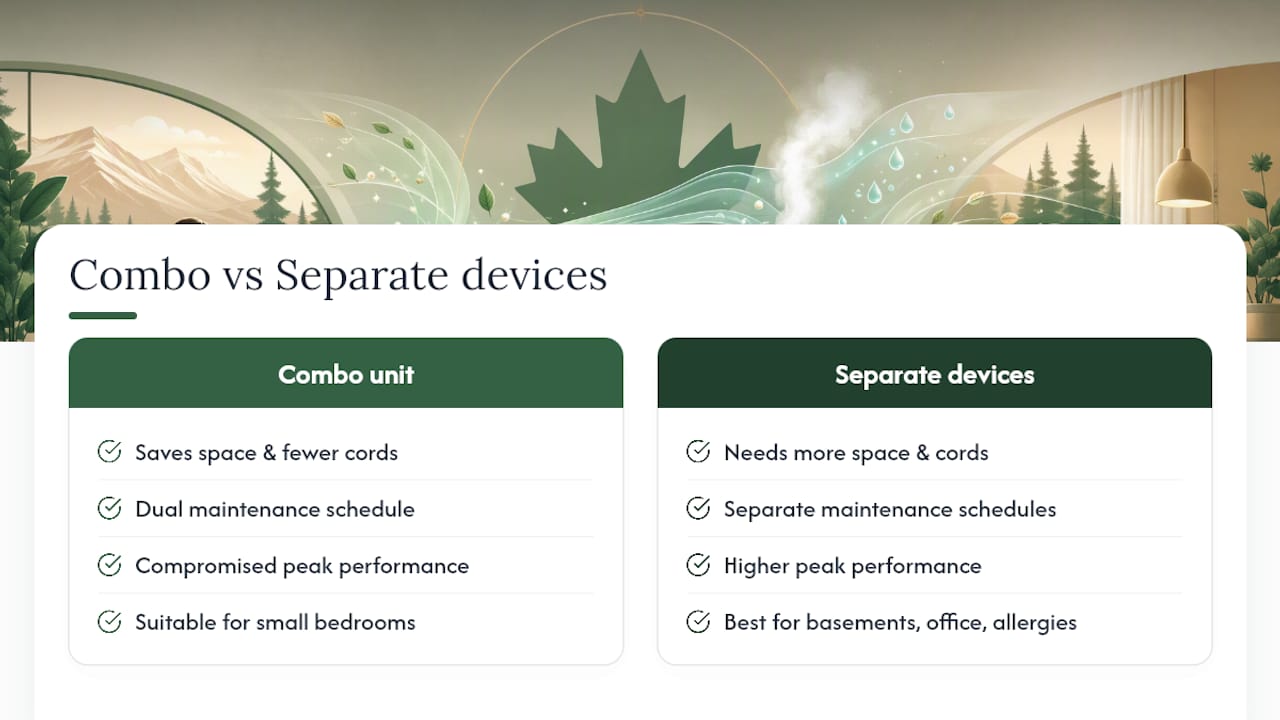
- Combo devices are space-saving but usually underperform in at least one function; dedicated units are preferable for allergy-prone or larger spaces needing maximum efficiency.
- Both devices require regular maintenance: weekly cleaning, filter replacement every three to six months, and careful water management to prevent bacterial or mold growth.
- Using an air purifier and humidifier simultaneously necessitates strategic placement and humidity monitoring to avoid filter clogging and mold development.
Table of Contents
- Air purifier or humidifier: quick answer for common scenarios
- How does an air purifier actually clean your air?
- How does a humidifier add moisture, and what does it actually fix?
- What do Health Canada and Johns Hopkins say about health effects?
- When should you choose a purifier, a humidifier, or both?
- Can you run an air purifier and a humidifier in the same room?
- What maintenance keeps these devices safe to use?
- Are these devices safe for a nursery or bedroom overnight?
- Should you buy a combo unit or two separate devices?
- What ValuHub’s team learned putting this guide together
- Which ValuHub devices fit these use cases?
- Sources
- FAQ
Air purifier or humidifier: quick answer for common scenarios
If you’re waking up with a stuffy nose and itchy eyes, get an air purifier. If your skin is cracking and your throat burns every morning in January, a humidifier is the fix. Wildfire smoke drifting into the house calls for a purifier with a true HEPA filter; a baby’s nursery in a dry Prairie winter usually calls for a humidifier with a built in hygrometer.
Here’s what to look for when you’re shopping, based on the actual problem you’re solving:
- Allergies, pet dander, or wildfire smoke: look for true HEPA filtration and a CADR rating matched to your room size.
- Dry skin, sore throat, bloody noses, or static shock: look for a humidifier with an adjustable humidistat and a sufficiently sized tank.
- Both dry air and dust/allergens: you may need two devices rather than one, since a combo unit often means compromises in both jobs, according to Tom’s Guide.
Combo units exist, and they save counter space. But they’re rarely the strongest performer at either job, which matters more in a bedroom than a hallway.
How does an air purifier actually clean your air?
An air purifier pulls room air through a filter (or several stages of filters) and pushes it back out, trapping particles as it goes. True HEPA filters catch at least 99.97% of particles down to 0.3 microns, which covers most dust, pollen, mold spores, and pet dander. Activated carbon layers, often bundled into the same unit, absorb odours and some gases that HEPA filters can’t touch on their own.
Sizing matters more than most shoppers realize. Purifiers carry a CADR (Clean Air Delivery Rate) number, and matching that number to your square footage is the difference between a device that actually works and one that just hums quietly in the corner. Health Canada recommends sizing a portable air cleaner to the specific room, not the whole house, and running it continuously rather than switching it on only when the air feels bad.
Here’s the basic sizing logic:
- Measure your room’s square footage.
- Look for a CADR rating close to two thirds of that number for smoke, dust, and pollen combined.
- Run the unit on a low or auto setting around the clock rather than cycling it on and off.
Pro Tip: Skip ionic or ozone-generating purifiers for a bedroom. Ozone is itself a lung irritant, and it does nothing that a true HEPA filter doesn’t already do more safely.
Filters need swapping every three to six months depending on use and local air quality. A unit that never asks for a filter change probably isn’t filtering much.
How does a humidifier add moisture, and what does it actually fix?
A humidifier’s job is simple: put water vapour into dry air so your throat, skin, and sinuses stop feeling like sandpaper. How it does that varies by type, and the type you pick changes your maintenance workload more than most buyers expect.
- Cool-mist humidifiers use a wick or ultrasonic disc to release room-temperature vapour; they’re the safer pick around kids since there’s no heating element.
- Warm-mist humidifiers boil water before releasing it, which can help loosen congestion but adds a burn risk near curious hands.
- Ultrasonic humidifiers are quiet and efficient but can leave a fine white mineral dust on furniture if you use tap water instead of distilled.
The benefits show up fast: less nosebleeds, less static shock, softer skin, and a throat that doesn’t wake you up at 3 a.m. Dry air also pulls moisture out of hardwood floors and wood furniture, so a humidifier protects the house itself, not just the people in it.
Pro Tip: Buy a humidifier with a built-in humidistat, not just a mist dial. Guessing at humidity by feel almost always overshoots into the range where mold starts to grow.
Whatever type you choose, cleaning matters more than the marketing copy suggests, and that’s the next problem worth solving.
What do Health Canada and Johns Hopkins say about health effects?
The clinical picture is straightforward: HEPA filtration reduces exposure to allergy and asthma triggers, while humidifiers relieve symptoms tied to dry indoor air, according to Johns Hopkins Medicine. Neither device is a cure for a chronic condition. Both can meaningfully reduce day-to-day symptoms when matched to the right problem.
The maintenance risk is real, and specific: Health Canada warns that cool-mist humidifiers left uncleaned can harbour bacteria and mold, which then get sprayed directly into the air you breathe. A device meant to help your lungs can work against you within a week of neglect.
Air purifiers carry a smaller but still notable caution: avoid ionic or ozone-generating models, since ozone itself irritates airways rather than clearing them. Stick with true HEPA for particulate control, and treat a humidifier’s water tank the same way you’d treat a coffee maker’s reservoir. It needs regular emptying and scrubbing, not just topping up.
When should you choose a purifier, a humidifier, or both?
Three questions settle most of this decision fast:
- Is your main complaint dust, pollen, pet dander, or smoke smell? That’s a purifier problem.
- Is your main complaint dry skin, cracked lips, nosebleeds, or a scratchy throat that eases with a hot shower? That’s a humidifier problem.
- Do you have both sets of symptoms at different times of year? You likely need both devices, just not necessarily running side by side every day.
Seasonal patterns make this easier to plan for. Winter heating dries indoor air across most of Canada, which is peak humidifier season. Spring pollen and summer wildfire smoke both call for the purifier to run continuously with the windows shut. A household near a major road or with indoor pets often needs the purifier running year round regardless of season, since dander and traffic particulates don’t take a break in July.
Can you run an air purifier and a humidifier in the same room?
Yes, and many households should. The trick is placement and monitoring, not just plugging both in and hoping.
- Keep the two devices at least a few feet apart, ideally on opposite sides of the room, so the purifier isn’t pulling in mist straight from the humidifier’s output.
- Track humidity with a hygrometer and keep the room between 30% and 50%, a range that avoids both dry-air symptoms and the mold-friendly conditions that show up above 50%.
- Use distilled water in the humidifier to cut down on the white mineral dust that ultrasonic units otherwise send airborne.
That mineral dust matters beyond just furniture. It can settle directly onto your purifier’s filter and shorten its working life, so the two devices genuinely affect each other’s maintenance schedules.
Pro Tip: If you’re running both in a small bedroom, angle the purifier’s intake away from the humidifier’s mist plume. It’s a five-second adjustment that meaningfully cuts filter clogging.
What maintenance keeps these devices safe to use?
Skipping maintenance is where both devices turn from helpful to counterproductive. A simple checklist keeps things on track:
- Daily: empty and refill humidifier tanks with fresh water; don’t let standing water sit for days.
- Weekly: disinfect the humidifier tank and wick per Health Canada’s cool-mist guidance, and vacuum the purifier’s pre-filter if it has one.
- Monthly: check the purifier’s HEPA filter for discolouration or reduced airflow.
- Every 3 to 6 months: replace the HEPA filter outright, sooner in high-pollen or high-smoke seasons.
Stop using either device and get a professional opinion if you notice a persistent musty smell from the humidifier, visible mold in the tank, or a purifier that’s blowing noticeably less air than it used to. Those are signs the device is adding contaminants rather than removing them.
Are these devices safe for a nursery or bedroom overnight?
A nursery is one of the few rooms where getting this right matters daily. Place the humidifier out of a baby’s reach, never on a soft surface like a carpet or crib blanket where spilled water can pool. A humidistat set to hold around 40 to 50% keeps skin comfortable without tipping into mold territory.
- Run the purifier continuously on its lowest or “sleep” fan speed rather than switching it off during the day.
- Choose a humidifier model with a genuinely quiet motor, since ultrasonic units are typically quieter than evaporative ones for sleep.
- Keep both devices easy to reach for weekly cleaning. A humidifier tucked behind furniture rarely gets cleaned on schedule.
Nightlight-equipped humidifiers, like compact bedside units built for kids’ rooms, solve two problems at once for a nursery without adding a second gadget to the shelf.
Should you buy a combo unit or two separate devices?
A combo purifier-humidifier saves counter space and cuts down on cords, but it typically means two maintenance schedules crammed into one housing and a compromise in peak performance for at least one function, as Tom’s Guide notes. A premium combo can work fine for a small apartment bedroom. For a basement, a home office, or anyone with real allergy or asthma concerns, two dedicated devices sized properly for the space will consistently outperform a single all-in-one box.
What ValuHub’s team learned putting this guide together
ValuHub Team builds buyer’s guides by pairing Health Canada and clinical guidance with the practical filters shoppers actually use: room size, tank capacity, noise level, and maintenance effort. Match this article’s recommendations to those same filters on any product page before you buy. Our pet hair vacuum guide covers a related indoor air issue worth checking if pet dander is part of your problem.
— ValuHub Team
Which ValuHub devices fit these use cases?
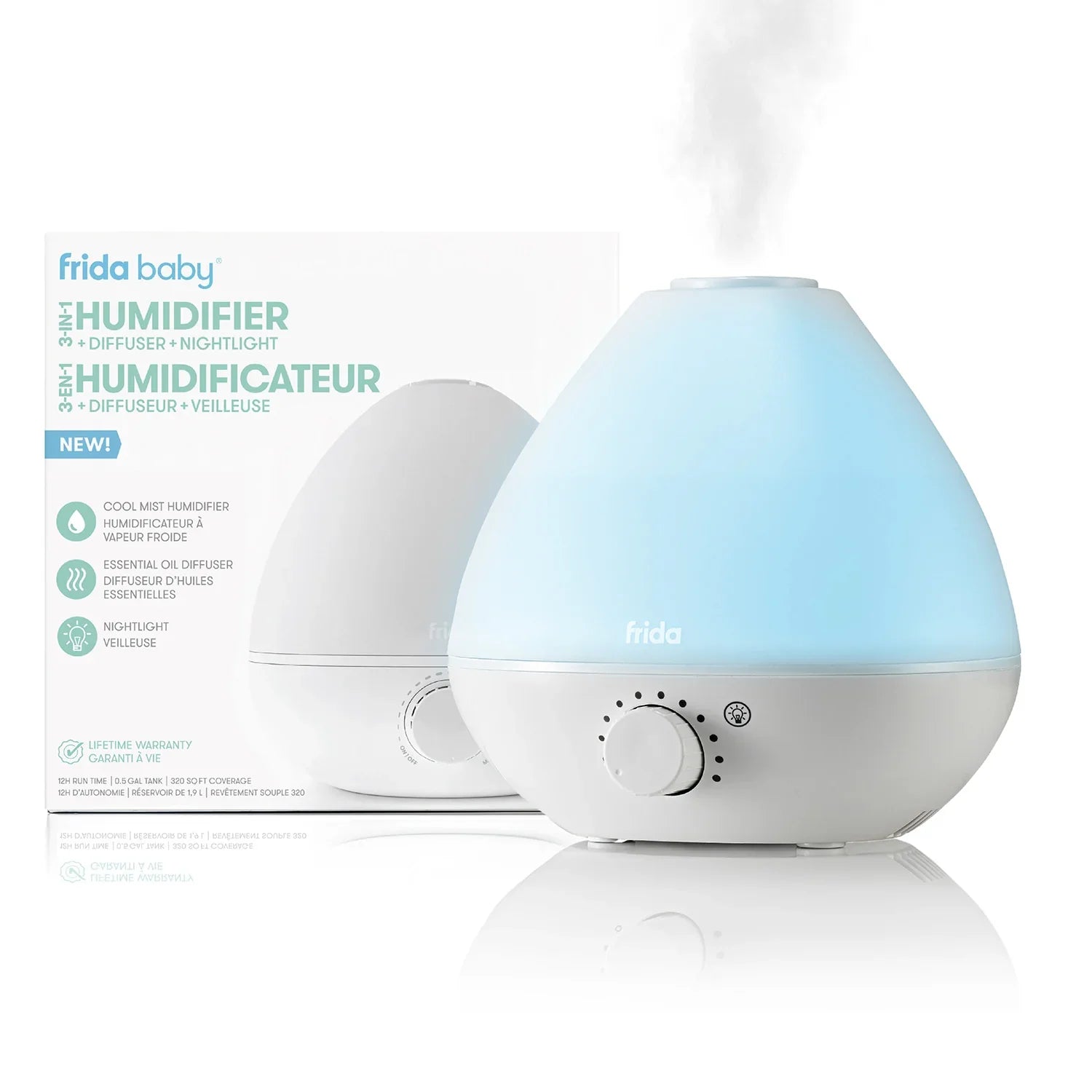
If your basement or laundry room runs damp rather than dry, the 1260 sq.Ft Portable Quiet Dehumidifier handles single-room moisture control with three operating modes, without the bulk of a whole-house unit. For a nursery or bedside table, the BreatheFrida 3-in-1 Humidifier Diffuser Nightlight covers humidity, scent, and soft lighting in one small footprint, which solves the nursery placement problem this guide raised earlier. If you’re dealing with a damp basement or a large finished space instead, the 100 Pint Smart Dehumidifier covers up to 5,200 square feet with app and voice control, so you can check humidity levels without walking downstairs.
Before buying any of these, check the product page for coverage area, tank or drain hose capacity, and the return policy. All three ship from Canadian warehouses, and orders over a certain amount qualify for free shipping, so pairing a humidifier with a dehumidifier for a mixed-humidity home often clears that threshold in one order.
Sources
- Canada
- Air filters, dehumidifiers, and humidifiers | Johns Hopkins Medicine
- Air purifier vs humidifier — Tom’s Guide
FAQ
Is it better to have a humidifier or an air purifier?
Neither is universally better; it depends on your symptom. Choose a purifier for allergies, pet dander, or smoke, and a humidifier for dry throat, cracked skin, or nosebleeds.
What are the disadvantages of an air purifier?
Air purifiers do nothing for dry air, need regular filter replacement every three to six months, and ionic or ozone-generating models can irritate airways rather than help them.
Is it safe to sleep with an air purifier and a humidifier running together?
Yes, provided you keep the devices a few feet apart, use a hygrometer to hold humidity between 30% and 50%, and clean the humidifier tank weekly to avoid bacteria growth.
Can an air purifier help with a dry throat?
Not directly. An air purifier filters particles, not moisture, so a dry throat almost always calls for a humidifier instead, or alongside a purifier if allergens are also a factor.
Do I need both a humidifier and a dehumidifier?
Only if different rooms in your home have opposite problems, such as a dry bedroom and a damp basement. Most households need one or the other, not both, in the same space.
Recommended
Made with BabyLoveGrowth to reach more people through search


